Free Shipping On All Orders Over $75
Free Shipping on all orders over $75 Australia Wide
Free Shipping On All Orders Over $75
Free Shipping on all orders over $75 Australia Wide
Showing the single result
People with high arches, also known as Pes Cavus, often need a very different type of insole or orthotic from someone with flat feet or excessive pronation. While low-arched feet commonly need support and control, high-arched feet frequently require a combination of appropriate arch contouring, pressure redistribution and—very importantly—generous cushioning and shock absorption.
This is because a high-arched or cavus foot can be relatively rigid. Instead of adapting readily to the ground and using normal pronation and supination to help manage impact forces, the foot may remain comparatively stiff during walking or running. Pressure can therefore become concentrated beneath relatively small areas of the heel and forefoot.
Research supports this distinction. A study comparing people with Pes Cavus with normal feet found significantly greater pressure-time integrals in the heel and forefoot of people with cavus feet, while foot pain was also substantially more common. (ScienceDirect)
Pes Cavus is the medical term for an abnormally high-arched foot. The medial longitudinal arch—the arch running along the inside of the foot—remains unusually elevated when standing and walking.
However, Pes Cavus is more complex than simply having a high arch. Depending on its severity and cause, a cavus foot may also feature a heel that tilts inward (rearfoot varus), a plantarflexed first metatarsal, forefoot changes and sometimes clawing of the toes. (MDPI)
Some people simply have naturally high arches and experience few problems. In other cases, a pronounced or progressively worsening cavus foot can be associated with an underlying neurological condition. A markedly high arch—particularly one that is worsening, asymmetric or accompanied by muscle weakness—therefore warrants professional assessment.
Supination describes a movement in which the foot becomes a more rigid structure, involving a combination of movements across the joints of the foot. In everyday language, however, people often use “supination” or “underpronation” to describe a foot that tends to remain toward its outer border during standing, walking or running.
Supination itself isn’t abnormal. In fact, both pronation and supination are essential components of normal foot function.
During the earlier stages of walking, the foot normally pronates to some degree. This helps it become a more adaptable structure that can accommodate the ground and manage loading. Later, the foot moves toward supination, becoming more rigid so that it can act as an effective lever for propulsion.
The problem with some high-arched feet is that they may be relatively rigid and spend less time functioning as an adaptable, pronated structure.
In simple terms:
A normal foot needs to be flexible when absorbing load and relatively rigid when pushing off.
A rigid Pes Cavus foot may be less capable of making that transition effectively.
A high arch means that less of the plantar surface of the foot may contact the ground. Instead of distributing forces broadly across the heel, midfoot and forefoot, loading can become concentrated predominantly beneath the heel and ball of the foot.
A 2005 study involving people with idiopathic and neurological Pes Cavus found that 60% of participants with cavus feet reported foot pain, compared with 23% of those with normal feet. The researchers also found significantly higher pressure-time integrals beneath the whole foot, rearfoot and forefoot. (ScienceDirect)
This can help explain why people with high arches may experience problems such as:
Not everyone with high arches develops these problems, and the precise biomechanics vary considerably between individuals.
One of the most important features of an insole for high arches or supination is cushioning.
The reason becomes clearer when we look at how the foot normally handles impact.
The human foot isn’t supposed to behave like a completely rigid block. During walking and running, its joints and soft tissues allow it to adapt and deform under load. Pronation forms part of this complex loading response.
A rigid cavus foot may have less capacity to adapt to the ground. Consequently, an appropriate insole can help by introducing external cushioning and increasing the area over which forces are distributed.
This doesn’t mean that the softest possible insole is automatically the best. An extremely soft material that simply collapses under body weight may provide little useful pressure redistribution.
An effective high-arch insole should therefore combine cushioning with an appropriate three-dimensional shape.
A good starting point is a full-length cushioned orthotic rather than a very thin or highly rigid device.
The arch contour should correspond reasonably closely to the foot. The objective isn’t necessarily to “push the arch up” even higher. Instead, contact through the arch can increase the effective load-bearing surface and help redistribute pressure away from overloaded areas.
Forefoot cushioning is especially important because cavus feet frequently experience greater loading beneath the metatarsal region. Heel cushioning can similarly help attenuate impact beneath the calcaneus.
Some people may also benefit from a metatarsal pad or metatarsal raise, which is positioned just behind the metatarsal heads to help redistribute forefoot pressure.
The precise orthotic prescription becomes more important when significant rearfoot varus, forefoot deformity or cavovarus alignment is present. These cases may benefit from assessment by a podiatrist rather than simply choosing an aggressive high-arch support off the shelf.
One of the most useful studies is a randomized controlled trial involving 154 people with chronic foot pain and bilateral cavus feet. Participants received either custom foot orthoses or sham insoles.
After three months, the custom-orthotic group experienced significantly greater improvements in foot pain and function, while plantar pressure also improved significantly compared with the control group. (PubMed)
Read the Pes Cavus orthotic study on PubMed
A later analysis of the same trial investigated why the orthoses worked. The researchers concluded that redistributing plantar pressure, rather than simply reducing the magnitude of pressure everywhere, appeared to be an important mechanism associated with pain relief. (PubMed Central (PMC))
Read the pressure-redistribution research
More recent research has also examined high-arched feet during running. A 2024 study found greater pressures in parts of the forefoot and heel in runners with subtle cavus feet compared with normal-arched participants. Personalized orthotic insoles redistributed several of these plantar-pressure measurements. (PubMed Central (PMC))
A systematic review and network meta-analysis likewise concluded that foot orthoses show potential as a conservative intervention for Pes Cavus, although the evidence base remains relatively small. (MDPI)
This distinction is important when choosing an orthotic.
Someone with a flexible, excessively pronating flat foot may benefit from an orthotic designed primarily around controlling excessive motion.
A person with a rigid, high-arched and relatively supinated foot presents a different problem. Adding an excessively hard or aggressive device beneath an already rigid foot may not provide the comfort or pressure redistribution required.
For many people with Pes Cavus, the priorities are therefore:
support + pressure redistribution + cushioning + shock absorption.
A well-designed insole should comfortably contour the arch while providing substantial cushioning beneath the heel and forefoot.
The shoe matters too. A cushioned, stable shoe with sufficient internal volume for the orthotic can complement the insole. An excellent orthotic inside a hard, poorly fitting shoe is unlikely to provide an ideal result.
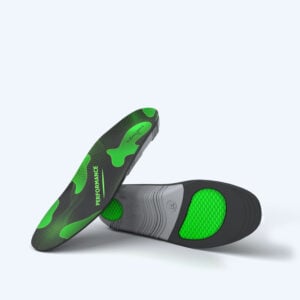
The best insoles for high arches generally combine good arch contact with substantial cushioning and pressure redistribution. Look for a full-length design with cushioning beneath the heel and forefoot rather than assuming that the highest or hardest arch support is best.
No. Pes Cavus describes a high-arched foot structure, while supination describes movement or position of the foot.However, high-arched feet are often associated with a relatively supinated or cavovarus posture, which is why the terms are frequently used together.
There isn’t one answer for everyone. A rigid cavus foot often benefits from substantial cushioning, while the orthotic itself needs enough structure to redistribute pressure effectively. Research suggests that appropriately designed orthoses can improve pain, function and plantar-pressure distribution in people with painful Pes Cavus. (PubMed)
Orthotics can sometimes help manage the pressure distribution and biomechanical consequences associated with a relatively supinated foot, but the design needs to suit the individual’s foot structure. Significant cavovarus alignment or repeated ankle instability should be assessed professionally rather than treated simply by purchasing the strongest arch support available.
Many high-arched feet have a relatively rigid structure and may not adapt to loading as effectively as a more flexible foot. Plantar pressure can consequently become concentrated beneath the heel and forefoot. Cushioning helps absorb impact, while a properly contoured orthotic can increase contact area and redistribute pressure. Research has demonstrated abnormal plantar loading patterns in people with Pes Cavus and supports pressure redistribution as an important mechanism of orthotic therapy. (ScienceDirect)
When looking for the best insoles for high arches and supination, don’t focus exclusively on the height of the arch support. A high-arched foot often needs something more sophisticated: an orthotic that supports the natural contours of the foot while compensating for its reduced ability to absorb and distribute loading.
For many people, that means a full-length orthotic with substantial heel and forefoot cushioning, good arch contact and effective pressure redistribution.
The objective isn’t to force the foot into a supposedly “perfect” position. It is to create a more comfortable interface between the foot, shoe and ground—reducing excessive localised loading while supporting more comfortable walking, standing and exercise.
For severe Pes Cavus, progressive changes, recurrent ankle sprains, weakness or persistent pain, a podiatrist, physiotherapist or appropriately qualified clinician should assess the underlying cause and determine whether a customised orthotic is required.